I recently came across a press release in Nature about an 'app' to rate research articles that have not been peer-reviewed, but are available in an online preprint service. It is called Papr. The idea is that you rate a paper based on its title and abstract, by swiping in your phone or dragging in your PC.
You can rate the manuscripts deposited in the biorXiv preprint in four categories:
1. Exciting and probable
2. Exciting and questionable
3. Boring and probable
4. Boring and questionable
I gave it a try as I was curious, but unlike tinder where you can make a snap judgement in a fraction of a second, it takes time to assess fairly a scientific abstract. Even more so if it falls outside your expertise.
You cannot truly judge a paper probable and questionable without giving the abstract a good detailed read, which will already consume quite a few minutes. Not only that, but also if you take into account that most abstracts will fall outside your field of expertise it gets quite tedious after reading just 3 or 4 abstracts.
Moreover, I think it can be potentially very harmful to judge papers as exciting or boring...
Imagine the scenario in which a PhD student from a university in Bolivia spent 5 years studying the effects of environmental change on the photosynthesis yield of a plant of local interest that you have never heard of. It is likely that the PhD student will not have the resources available to most research institutions in developed countries, and so this hypothetical student has only old equipment and virtually no funding to obtain the required data to complete the project.
Now imagine that the student uploaded a preprint of her work on the BiorXiv only to be rated by some fools as Boring and Questionable in a snap microsecond judgement. Rated by some entitled fools that do not understand anything at all about the difficulties of doing research in a developing country.
At the beginning I thought such an app could be fun, but after critically engaging with it, I think perhaps it is not such a great idea.
To the developers of this app I would advise to create an option to narrow the shown papers to the different subcategories that the BiorXiv offers (e.g. Biochemistry, Evolutionary Biology, Bioinformatics, etc). So that it is possible to rate something that is closer to your field of expertise. In addition, I would suggest to change the rating criteria to a numeric score from 1 to 5... but I have my doubts that any kind of value judgement of someones research is of any use at all.
Wednesday, June 21, 2017

Friday, June 16, 2017
The story of how I became interested in Photosystem II and photosynthesis
Photosystem II, the water oxidizing enzyme of photosynthesis, has been the main subject of my research since I was an undergraduate student. I have studied it using many different approaches from biochemical to evolutionary.
We have to go back to the year 2002 or 2003, I don't remember exactly. I was on my third or last year as an undergrad student in Biology. My good friend, who was also a biology student at a different university in Bogotá, was part of a journal/research club and one day he showed me this paper that he had come across for some reason:
Carrell TG, Tyryshkin AM, and Dismukes GC. (2002) An evaluation of structural models for the photosynthetic water-oxidizing complex derived from spectroscopic and X-ray diffraction signatures. Journal of Biological Inorganic Chemistry 7: 2-22.
This was a minirivew discussing possible structural models of the manganese cluster of Photosystem II. Way to advanced for me to understand much of it at the time. However, one of the things that hooked me at the time was the chemical reaction the Photosystem II catalyzes: the oxidation of two water molecules to oxygen, electrons, and protons. It all seemed so mysterious and sophisticated. I was then forever captivated by the subject...
Back in 2002, only one structure of Photosystem II was available at low resolution, 3.8 A. So, the manganese cluster was just a blob... see the figure below.
In 2011 a remarkable improvement on the structure of Photosystem II was published at 1.9 A. For the first time, each atom in the manganese cluster was resolved. See the figure below:
Now, I want to know how and when Photosystem II and its fascinating chemistry originated for the first time! If you're interested, check out my research!
We have to go back to the year 2002 or 2003, I don't remember exactly. I was on my third or last year as an undergrad student in Biology. My good friend, who was also a biology student at a different university in Bogotá, was part of a journal/research club and one day he showed me this paper that he had come across for some reason:
Carrell TG, Tyryshkin AM, and Dismukes GC. (2002) An evaluation of structural models for the photosynthetic water-oxidizing complex derived from spectroscopic and X-ray diffraction signatures. Journal of Biological Inorganic Chemistry 7: 2-22.
This was a minirivew discussing possible structural models of the manganese cluster of Photosystem II. Way to advanced for me to understand much of it at the time. However, one of the things that hooked me at the time was the chemical reaction the Photosystem II catalyzes: the oxidation of two water molecules to oxygen, electrons, and protons. It all seemed so mysterious and sophisticated. I was then forever captivated by the subject...
Back in 2002, only one structure of Photosystem II was available at low resolution, 3.8 A. So, the manganese cluster was just a blob... see the figure below.
 |
| From Carrell et al., 2002. Panels A and B were from the crystal structure of Zouni et al 2001. C, D and E, were possible models that were considered at the time. |
 |
| From Umena et al., 2011. This is how the structure of the Mn cluster of Photosystem II looks like today. |
Friday, June 2, 2017
Oxygen in Mars' Gale Crater. Is this evidence for life?
In a recent published Science article by Hurowitz et al (2017), Redox stratification of an ancient lake in Gale crater, Mars, it is suggested that there was atmospheric oxygen around in enough quantities to cause the oxidation of transition metals like iron and manganese, about 3.5 billion years ago. I was left with many questions regarding the questions, so I left the following commentary in the eLetters section:
The authors write: “The recognition of a stable
redox-stratified water body adds important detail to our understanding of the
potential for microbial chemoautotrophy within the ~3.8- to
3.1-billion-year-old Gale crater lake system.”
I am just wondering on what assumptions photoautotrophy is
excluded as a possibility. It is well known that, at the very least, anoxygenic
photosynthesis was ongoing 3.8 billion years ago (Nisbet & Fowler, 2014). While the exact date
for the origin of oxygenic photosynthesis on earth is debated, there are many
reports for the presence of biogenic oxygen hundreds of millions of years
before the Great Oxidation Event (Lyons et al., 2014). So it is not
unreasonable to think that some forms of biological water oxidation to oxygen
already existed before 3.0 billion years ago.
The authors write: “The model depends on the depth of
penetration of ultraviolet (UV) light and low levels of photochemically
generated atmospheric O2 into the water column
to establish a depth-dependent boundary between oxidized and anoxic zones”.
How much oxygen can be produced photochemically
on Mars? I am not a geochemist, but from discussions regarding the oxygenation
of Earth, I understand that it was an almost negligible contribution. With the
levels of O2 being only a maximum of 10-8 of the current
level by photochemistry alone (Kasting &
Walker, 1981). That is on Earth, Mars is farther from the
Sun and the young was fainter back then.
Unfortunately, I do not know the literature on
Mars early atmosphere, but is photochemical produced O2 really a
valid alternative?
What concentrations of oxygen do you need to account
for the level of iron and manganese oxides that you see?
Based on this work, can you put a minimum
constrain on the amount of oxygen present in the atmosphere of Mars at this
time?
Kasting, J. F.,
& Walker, J. C. G. (1981). Limits on oxygen concentration in the
prebiological atmosphere and the rate of abiotic fixation of nitrogen. Journal of Geophysical Research-Oceans and
Atmospheres, 86(Nc2), 1147-1158. doi:DOI 10.1029/JC086iC02p01147
Lyons, T. W., Reinhard, C. T., & Planavsky, N. J. (2014). The
rise of oxygen in earth's early ocean and atmosphere. Nature, 506(7488), 307-315. doi:10.1038/nature13068
Nisbet, E. G., & Fowler, C. F. R. (2014). The early history of
life. In K. D. M. & W. H. Schlesinger (Eds.), Treatise on geochemistry (2nd ed., Vol. 10, pp. 1-42). Amsterdam:
Elsevier Science.
 |
| Gale Crater, Mars. Was there ever life thriving in here? |
Thursday, June 1, 2017
Exponential decay in the change of the rate of evolution of photosynthesis protein
In my recent article on the evolution of Type II reaction centres, I showed how the rate of evolution of reaction center proteins has to approximate an exponential decay. With rates of evolution about 40 times larger in the early Archaean in comparison with rates seen since the Proterozoic.
 |
| Fig. 5 from https://doi.org/10.1101/109447. Panel (a) shows the exponential decrease in the rate of evolution of reaction center proteins as a function of divergence times. The max rate is about 40 times larger than the average rate seen in the Proterozoic. See the paper for more details. Panel (a) was calculated assuming an origin of photosynthesis around 3.5 billion years ago |
I have recently performed a molecular clock of ChlL and BchX, subunits of protochlorophyllide reductase chlorophyllide reductase, enzyme needed for the synthesis of chlorophyll and bacteriochlorophyll respectively. These enzymes, as you may have seen from my previous post, is related to NifH of nitrogenase and CfbC of methanogenesis. Surprisingly, the results are very similar to those of Type II reaction centers, see above. The change in the rate of evolution of ChlL/BchX of all phototrophic bacteria follows an exponential decay as well! See below:
 |
| Change in the rate of evolution of ChlL as a function of time. Orange are ChlL at different time points. Blue are NifH and CfbC. Both cases are fitted with an exponential decay, but the decay of the rate of evolution of nitrogenases and CfbC is not as pronounce. This were calculated assuming that the origin of life occurred around 3.8 billion years ago, quite a conservative estimate, which then locates the origin of photosynthesis at about 3.5 billion years ago. For this molecular clock analysis I used a completely different set of calibrations in comparison to the graph above. So... is it a coincidence? |
The exponential decay of Type II reaction centers needs to be explained some how. This is what we wrote in our paper, quoting:
The phenomenon described here of an initial fast rate of evolution
followed by an exponential decrease demands an explanation. Two possible
mechanisms may account for this observation. The first one is the temperature
dependent deamination of cytosine, as suggested by Lewis and coworkers (2016). They calculated that as the Earth cooled
during its first 4 Ga, the rate of spontaneous mutation would have fallen
exponentially by a factor of more than 4000. That is to say that the rate of
spontaneous mutation during the earliest stages in the history of life would
have been about three orders of magnitude greater than those observed since the
Proterozoic. Lewis and coworkers (2016) calculated that 50% of all spontaneous
mutations occurred in the first 0.2 Ga, which matches well with the exponential
decay trend seen in Fig. 5A, especially if an origin of photosynthesis is
considered to be about 3.8 Ga. The second possibility is higher UV radiation on
the planet’s surface during the early Earth in the absence of an ozone layer,
which could have resulted in rates of DNA damage up to three orders of
magnitude greater than in present day Earth, as calculated by Cockell (2000); this higher rate of damage may have led as well
to faster rates of change. Alternatively, both mechanisms could have
contributed simultaneously.
The striking differences between ChlL/BchX and nitrogenase/CfbC is kind of interesting. I wonder if the sharp decrease in the rates of Type II reaction centers and ChlL means that it may have actually been due to higher exposure to UV light, given the fact that these are phototrophic organisms, so they had to be in the photic zone... and there was not an ozone layer at that time, so UV radiation was many times greater.
To my surprise there are no detailed analysis of the change in the rates of evolution across geological time. These may actually be the first ones... I wish I could compare many more proteins of ancient origins, but it is not trivial, it takes a lot of time, and I don't have funding for a project like this at the moment.
Thursday, May 25, 2017
A new undescribed clade of ancient phototrophic bacteria in metagenomic data
Protochlorophyllide and chlorophyllide reductases,
two enzymes required for the synthesis of chlorophyll and bacteriochlorophyll
precursors share significant sequence identity with an enzyme required for the
synthesis of the Ni-tetrapyrrole, cofactor F430 of Methyl-coenzyme M reductase,
a key enzyme in methanogenic and methanotrophic archaea. These enzymes are also
closely related to nitrogenases, but the evolutionary relationships among the
tetrapyrrole synthesis enzymes and nitrogenases have been difficult to resolve.
Recent phylogenomic analysis have suggested that the last universal common
ancestor was capable of nitrogen fixation and methanogenesis, raising puzzling
questions about the early origin of photosynthesis and the early
diversification of the tetrapyrrole biosynthesis enzymes.
I serendipitously stumbled upon two sequences
annotated as ChlL subunits while searching for homologs to a subunit of the Ni-tetrapyrrole synthesis enzyme (CfbC) in a BLAST
restricted to the domain Archaea.
The ChlL subunits appeared in the recently
published genomes of of Candidatus Altiarchaeales archaeon WOR SM1 SCG and
Candidatus Altiarchaeales archaeon WOR SM1 86-2, hereafter named Alti_SCG and
Alti_86-2, respectively. An investigation of the genomic region surrounding the
putative ChlL contained the two additional subunits of protochlorophyllide
reductase, ChlB and ChlN, in the genome of Alti_86-2 but not in Alti_SCG1. However, after communication with the authors who sequenced the genomes of this strain it turns out that ChlB and N, in
The sequence from strain Alti_SCG has 81%
sequence identity to that if strain Alti_86-2 This suggests that they are quite
a distance apart, but still within “the same phylum”. These strains have 83.1% sequence identity of the 16S rRNA, which suggests that these strains diverged already quite some time ago.
I have performed ML phylogenetic analysis of the sequences that I retrieved and performed a quick molecular clock analysis of ChlL.

What you can see is that the Archeal sequences branch together with those of photosynthetic bacteria. They are indeed true subunits of protochlorophyllide reductase. This suggest that the proteins were acquired via horizontal gene transfer from a phototrophic bacterium.
Interestingly, the sequences do not branch within any of the known clades of phototrophic bacteria. From the phyllogeny of ChlN and B it would seem plausible that the sequences have some affinity to those in Heliobacteira, which may suggest that the source of the genes is a phototrophic Firmicutes distantly related to Heliobacteria... in fact, predating the divergence of Heliobacteria. This would be my most conservative guess. However, it may as well be a completely new phylum of bacteria.
One thing we can be sure of... the sequences do not match any of the known clades.
The molecular clock analysis, using a relaxed log-normal autocorrelated clock, with the CAT model, suggested that the event of horizontal gene transfer occurred about 1.3 +/- 0.4 billion years ago, as estimated by the divergence time of the ChlL from the two archeal strains.
From the position of the archaeal branches we can conclude that the "new clade" of phototrophic bacteria is an early evolving one... a really early one.
From the position of the archaeal branches we can conclude that the "new clade" of phototrophic bacteria is an early evolving one... a really early one.
Fascinating stuff. This is a pretty rough and quick analysis though, I'll need some time to study this in more detail... might even need a grant. Any donors? ;) Haha, I wish, right?
Thursday, March 23, 2017
Seeking answers in Asimov's Prelude to Foundation
Yesterday night as I was reading "Prelude to Foundation", the first prequel to Asimov's Foundation saga, I stumbled upon this marvelous quote:
“Why, he wondered, did so many people spend their lives not trying to find answers to questions—not even thinking of questions to begin with? Was there anything more exciting in life than seeking answers?”
― Isaac Asimov
I guess it is why I decided to be a scientist.
“Why, he wondered, did so many people spend their lives not trying to find answers to questions—not even thinking of questions to begin with? Was there anything more exciting in life than seeking answers?”
― Isaac Asimov
I guess it is why I decided to be a scientist.
 |
| Prelude to Foundation, cover art by Tim White |
Friday, March 3, 2017
Oxygen utilization in the Last Universal Common Ancestor
In the recent paper by Weiss et al 2016, in Nature Microbiology, eight oxygen-using enzymes were traced back to the last universal common ancestor. Listed below:
CtaD: Heme/copper-type cytochrome/quinol oxidase, subunit 1
SodC: Cu / Zn superoxide dismutase
BcpB: Peroxiredoxin
HmgA: Homogentisate 1,2-dioxygenase
KEGG Ortholog, K15746: hypothetical protein
LigB: Aromatic ring-opening dioxygenase, LigB subunit
HpaB: Aromatic ring hydroxylase
Rr-2: Rubrerythrin
There were more proteins related to oxygen utilization in LUCA than those categorized in nitrogen metabolism (seven proteins) and energy metabolism (two proteins).
Three of these enzymes are used to deal with radical oxygen species (ROS), SodC, BcpB, and Rr-2.
HmgA has a role in the catabolism of aromatic rings of tyrosine and phenylalanine. LigB and HpaB deal with the oxidation of aromatic rings and phenolic compounds.
HmgA has a role in the catabolism of aromatic rings of tyrosine and phenylalanine. LigB and HpaB deal with the oxidation of aromatic rings and phenolic compounds.
The first one in the list, the heme/copper-type cytochrome/quinol oxidase, is required for aerobic respiration.
The hypothetical protein is actually, CrtZ; beta-carotene 3-hydroxylase (a.k.a. beta-carotene, NADH:oxygen 3-oxidoreductase), used in the conversion of betacarotene to zeaxanthin.
Similar results have been published before regarding the ROS enzymes and the dioxygen reductases. See Ouzounis et al 2006 for example, or Zamocky et al 2001, or Brochier-Armanet et al 2009. These are just a few examples...
Of course, the results of Weiss et al 2016 and those by others before can be interpreted in a number of ways and there has always been great debate. If we stick to the simplest explanation, Occam's Razor: I would say that the simplest explanation is that molecular oxygen was available to the last universal common ancestor.
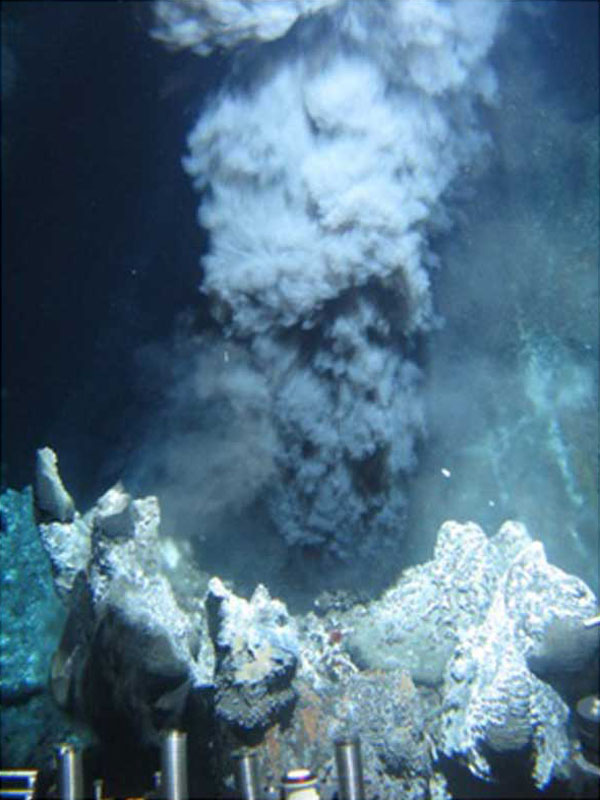 |
| Black Smoker, by NOAA [Public domain], via Wikimedia Commons |
Subscribe to:
Posts (Atom)