Thursday, March 23, 2017

Seeking answers in Asimov's Prelude to Foundation

Yesterday night as I was reading "Prelude to Foundation", the first prequel to Asimov's Foundation saga, I stumbled upon this marvelous quote:

“Why, he wondered, did so many people spend their lives not trying to find answers to questions—not even thinking of questions to begin with? Was there anything more exciting in life than seeking answers?”

― Isaac Asimov

I guess it is why I decided to be a scientist.

Prelude to Foundation, cover art by Tim White

Friday, March 3, 2017

Oxygen utilization in the Last Universal Common Ancestor

In the recent paper by Weiss et al 2016, in Nature Microbiology, eight oxygen-using enzymes were traced back to the last universal common ancestor. Listed below:

CtaD: Heme/copper-type cytochrome/quinol oxidase, subunit 1
SodC: Cu / Zn superoxide dismutase
BcpB: Peroxiredoxin
HmgA: Homogentisate 1,2-dioxygenase
KEGG Ortholog, K15746: hypothetical protein 
LigB: Aromatic ring-opening dioxygenase, LigB subunit
HpaB: Aromatic ring hydroxylase
Rr-2: Rubrerythrin

There were more proteins related to oxygen utilization in LUCA than those categorized in nitrogen metabolism (seven proteins) and energy metabolism (two proteins).

Three of these enzymes are used to deal with radical oxygen species (ROS), SodC, BcpB, and Rr-2.

HmgA has a role in the catabolism of aromatic rings of tyrosine and phenylalanine. LigB and HpaB deal with the oxidation of aromatic rings and phenolic compounds.

The first one in the list, the heme/copper-type cytochrome/quinol oxidase, is required for aerobic respiration.

The hypothetical protein is actually, CrtZ; beta-carotene 3-hydroxylase (a.k.a. beta-carotene, NADH:oxygen 3-oxidoreductase), used in the conversion of betacarotene to zeaxanthin.

Similar results have been published before regarding the ROS enzymes and the dioxygen reductases. See Ouzounis et al 2006 for example, or Zamocky et al 2001, or Brochier-Armanet et al 2009. These are just a few examples...

Of course, the results of Weiss et al 2016 and those by others before can be interpreted in a number of ways and there has always been great debate. If we stick to the simplest explanation, Occam's Razor: I would say that the simplest explanation is that molecular oxygen was available to the last universal common ancestor.

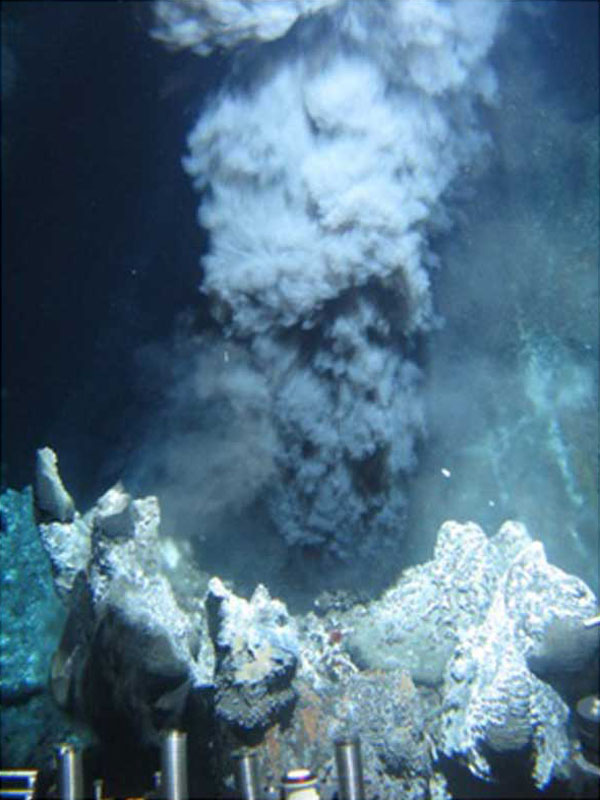
Black Smoker, by NOAA [Public domain], via Wikimedia Commons

Wednesday, February 22, 2017

Rates of evolution of reaction center proteins and other proteins of photosynthesis

I have been doing molecular clock analysis of several proteins and enzymes relevant to photosynthesis. This has allowed me measure the rate of evolution. Several of this I have presented in my recent paper available in bioRxiv, which I have just submitted for peer-review. I present here a few more of other unpublished projects.

The rates are given as amino acid changes per site per billion years

Photosystem II core protein - D1: 0.088
Photosystem II core protein - D2: 0.12
Anoxygenic Type II RC core protein - L: 0.63
Anoxygenic Type II RC core protein - M: 0.60

Photosystem I core protein - PsaA: 0.13
Photosystem I core protein - PsaB: 0.15
Anoxygenic Type I RC protein of heliobacteria - PshA: 0.27
Anoxygenic Type I RC protein of the Chlorobi - PscA: 0.24

Mg-chelatase: ChlD/BchD: 0.60 (average from all phototrophs)
Putative Co-chelatase homolog to ChlD: 0.73 (average from archaea strains)

These were calculated using Phylobayes 3.3f under a CAT model using the birth-death model and soft bounds on the calibrations points, assuming an age for photosynthesis around 3.5 billion years ago.

If you want more details, please look at the paper above or send me an email.

Saturday, January 21, 2017

Directed evolution of water oxidation catalysis for improved photosynthesis

Recently, a funding opportunity became available at Imperial open to all academic stuff at all levels. I participated with this little project about doing directed evolution on Photosystem II. The pre-proposal had to be really short so almost no considerations on the project can be really made. Only 1 proposal per department had to be put forward for the final round of selection. I ranked 3 out of 6...

The big issue I see with the project is that from an evolutionary perspective the rate of PSII water oxidation are limited not by the S cycle itself but by quinone exchange. The slow rates of quinone exchange at the same time are determined by the rates of quinone oxidation in the cytochrome b6f and other downstream processes.

It would be fun to prove that water oxidation can occur faster than it does. The directed evolution approach will probably have to also accelerate the rates of quinone exchange in PSII and also downstream in the thylakoid membrane and metabolic electron sink.

Summary of the project
Raising populations and greater incomes per capita will result in an unprecedented demand for food, fuel, and high-value products. This demand will not be met without an improvement of the efficiency of photosynthesis: the ultimate frontier in photosynthesis research. The engine that powers photosynthesis is called Photosystem II, a complex molecular machine that converts light into useful energy by decomposing water into protons, electrons, and oxygen. This chemical reaction is known as water oxidation and it is the source of all energy that sustains complex life and human societies. I hypothesise that Photosystem II has the potential to oxidise water several-fold faster than observed in known photosynthetic organisms. To test this hypothesis I will use directed evolution to select for variant Photosystem II with accelerated rates of water oxidation. The project aims to provide experimental support for the possibility of enhancing the catalytic efficiency of Photosystem II. The results of this innovative and high-risk project have the potential to be directly translated into strategies for the engineering of enhanced photosynthetic organisms.

Proposal 
It is likely that in the next decades the global demand for food, fibre, bioenergy, biopharmaceuticals, and other chemical precursors will not be met sustainably without significant improvements of the photosynthetic efficiency of crops and algae of biotechnological potential.1,2
A radical and high-risk approach that could result in a significant enhancement of photosynthetic efficiency is the direct improvement of the rate of catalysis of Photosystem II, the light-driven water:plastoquinone oxidoreductase enzyme of oxygenic photosynthesis. I will employ directed evolution to screen and select for Photosystem II variants that display faster rates of water oxidation. The specific goal of the project is to demonstrate that faster rates of biological water oxidation are catalytically and thermodynamically possible.
Gene diversification will be accomplished using genome-wide random mutagenesis3 and iterative saturation mutagenesis4 of the core subunits of Photosystem II targeting the first and second coordination sphere of the Mn4CaO5 cluster, the exchangeable plastoquinone binding site, and the proton pathways. Cyanobacteria mutants will be screened for potential alterations in water oxidation photochemistry in a plate reader spectrometer using a range of oxygen sensitive dyes. Strains with potentially faster kinetics of water oxidation will be extensively characterised with the range of electrochemical, spectroscopic, and biochemical techniques available in my lab. Successful variants from both gene diversification strategies could be integrated using DNA shuffling.

                The accomplishment of improved catalytic efficiency of Photosystem II would be a tremendous breakthrough and should open a direct route for the technological realisation of enhanced photosynthesis in crops, eukaryotic algae, and cyanobacteria. Furthermore, it should expedite the development of artificial catalysts that mimic the water oxidation cycle, which still remains an outstanding technological challenge.5,6


1. Ort, D. R. et al. Redesigning photosynthesis to sustainably meet global food and bioenergy demand. PNAS, 112, 8529-8536, (2015).

2. Tilman, D., Balzer, C., Hill, J. & Befort, B. L. Global food demand and the sustainable intensification of agriculture. PNAS, 108, 20260-20264, (2011).

3. Packer, M. S. & Liu, D. R. Methods for the directed evolution of proteins. Nat Rev Genet 16, 379-394, (2015).

4. Reetz, M. T. & Carballeira, J. D. Iterative saturation mutagenesis (ISM) for rapid directed evolution of functional enzymes. Nat Protoc 2, 891-903, doi:10.1038/nprot.2007.72 (2007).

5. Zhang, C. X. et al. A synthetic Mn4Ca-cluster mimicking the oxygen-evolving center of photosynthesis. Science 348, 690-693, (2015).

6. Schulze, M., Kunz, V., Frischmann, P. D. & Wurthner, F. A supramolecular ruthenium macrocycle with high catalytic activity for water oxidation that mechanistically mimics Photosystem II. Nat Chem 8, 577-584, (2016).

Monday, January 16, 2017

The uncanny connections between methanogenesis and photosynthesis

I have become quite interested in the evolutionary relationship between methanogenesis in archaea and photosynthesis in bacteria.

The first evolutionary link comes from the homology between the two enzymes of chlorophyll and bacteriochlorophyll synthesis, Protochlorophyllide reductase (BchLNB or ChLNB) and Chlorophyllide reductase (BchXYZ), and the enzyme required for the synthesis of the Ni-tetrapyrrole cofactor, coenzyme F430, of methyl-coenzyme M reductase, which is essential for methanogenesis. 

Another enzyme of chlorophyll synthesis, BciB (8-vinyl reductase) may also be related to another enzyme of methanogenesis (FrhB). See this paper.

Now a new paper by Kono et al (2017) seems to find that this evolutionary link goes much deeper, as it seems that methanogenic archaea not only have a proper rubisco, but also have phosphoribulokinase (PRK), previously considered to be unique to photosynthetic organisms that use the Calvin-Benson-Bassham cycle for carbon fixation.

I know that some enzymes of methanogenesis seem to trace back to the last universal common ancestor (LUCA), but the same isn't true for photosynthesis. From this perspective it would seem that photosynthesis emerged perhaps by borrowing a few components from methanogenesis.

Recently, Martin et al (2017) said in a recent perspective: "Let us presume, just for a moment, that the first bacteria and archaea were acetogens and methanogens respectively. On an uninhabited planet, they have no competitors, and life multiplies quickly given ample growth substrates. The founders of their respective domains would have bubbled off into the ocean bottom waters to be spread around by currents and eventually to be introduced back into hydrothermal systems in the crust [...]"

I would add to this, that life could have only spread around the globe and take a hold during the early Archaean after the evolution of photosynthesis. In fact, I would go as far as to say that it was the innovation of photosynthesis what allowed the early microbes to escape the hydrothermal vents and the crust... but other may disagree! :)

Stromatolitic-chert member, Strelley Pool Formation, middle to lower Paleoarchean, 3.35 to 3.46 Ga. Photo by James St. Johns.


Wednesday, June 29, 2016

Just thinking about things can be a source of scientific progress

I just read "One step beyond a ribosome: The ancient anaerobic core", by Filipa L. Sousa, Shijulal Nelson-Sathi, William F. Martin, published in Biochimica et Biophysica Acta 1857 (2016) 1027–1038

It is a fascinating paper. I particularly enjoyed the following concluding line:

"With regard to the most primitive forms of microbial physiology, microbiologists reached the same conclusion 45 years ago, namely that methanogens and acetogens probably represent the most ancient lineages. We required 2000 genomes and powerful computers for our conclusions, while Decker et al. just thought about it. Evidently, just thinking about things can be a source of scientific progress."

I like to think about things, I like to think especially about photosynthesis ;)

Fossil stromatolite

Thursday, April 21, 2016

The letter that kick-started my science career

When I was finishing my undergraduate studies in Colombia, early 2004, I found myself quite confused because I didn't know what to do with my degree in biology... there used to be so little research done in Colombia that becoming a researcher in Colombia seemed like a incredibly remote possibility. I wasn't really into field-work and found slugs and other critters really disgusting to the touch, so I wasn't going to find myself in the jungle anytime soon. The only thing that seemed like a possibility was to teach biology in a high-school, but that wasn't really motivating me either. Nevertheless, I was incredibly interested in photosynthesis research!

Everything changed when I received some good advice from my final-year-project supervisor. He suggested that I should contact laboratories around the world and ask for postgraduate positions. That little piece of advice changed my life! I then proceeded to contact every laboratory in the world doing research in Photosystem II, my favorite subject. From many places I never heard back, but a couple of them were quite interested: Sweden in particular.

This is the unaltered letter that I sent to Prof. Stenbjörn Styring at Uppsala University. He then invited me to do a PhD in his lab. I traveled to Sweden two months after I got my Biology certificate.


My name is Tanai Cardona Londoño, I am a 21 years old Biologist from the University of los Andes, in Bogotá, Colombia. Next September I shall receive my undergraduate title. In consequence, I have begun to approach myself toward my professional and scientific goals: the study of the water oxidation by the oxygen-evolving complex. 

Throughout the four and a half years of universitary studies, I have been marveled with the amazing mechanism of photosystem II and its redox chemistry. Inevitably, I have had to meet with the extensive publications from your group, as well as those of other research centers around the world. Therefore, I have been reading about a great variety of related subjects, from the crystallographic structures and spectroscopic measurements to the evolutionary proposals of its appearance in nature. 

In that way, I decided to write for my graduation thesis a monograph about the recent advances in WOC-PSII structure and function, in order to familiarize me with the current investigations in the field. I took the decision to elaborate a bibliographic revision because there is neither anybody nor a laboratory interested and equipped in photosynthesis research around the whole boundaries of Colombia. However, I have been directed by a plant molecular biologist Ph.D.―who advise me to write you. 

Now that I am close to end my undergraduate studies, I am very interested to begin my postgraduate studies in the fields of structural biology or biochemistry; ideally centered in the investigation of the structure and function of metalloenzymes, especially PSII. That is the reason which motivate me to write this letter, namely to look for the possibility of join me with your research group. This would be invaluable for my scientific growth. At the same time, I would give all my effort and capabilities of working hard. 

I was wondering if there is a possibility for linking me with your research team and simultaneously begin my postgraduate studies with a fellowship or some other kind of economical support. If there is, please tell me what should I do to get this great opportunity. If there is not such opportunity, nevertheless, it has been a great pleasure to write you. 

Sincerely,

Tanai


Uppsala, Sweden